
Why Restoration best practices: 360 imaging documentation and estimator reputation?
Restoration best practices: 360 imaging documentation and estimator reputation
When water strikes, clear evidence and trusted estimates matter more than ever. Restoration best practices: 360 imaging documentation and estimator reputation should be part of every mitigation plan because they reduce disputes, speed claims, and protect homes.
Why this matters
Water damage moves fast. As a result, accurate documentation saves time and money. Reliable estimator reputations build trust with homeowners, adjusters, and contractors. Together, they create transparency and reduce repeat site visits.
Key benefits
- Capture a complete room view in about 20 seconds using 360 imaging. This cuts follow up visits.
- Create layered walkthroughs: initial inspection, post-demo, and after equipment placement. This builds a timeline of documentation.
- Share 360 tours with adjusters and customers as visual proof to support estimates.
- Maintain professionalism on every call and email to protect estimator reputation.
Types of water damage where 360 imaging is most beneficial
- Multiroom flooding from burst mains or supply line failures. 360 imaging documents scope across rooms.
- Storm and surface flooding that affects structural elements and finishes.
- Complex losses with hidden damage behind walls, ceilings, or under floors.
- Large commercial or multiunit residential jobs where a single walkthrough misses details.
Practical note
Pro Tip: Make multiple walkthroughs part of your standard process. It is a small step that delivers big benefits in accuracy and transparency.
Further reading on standards and safety
For technical standards and guidance, consult the Institute of Inspection Cleaning and Restoration Certification. For federal disaster and recovery guidance, see FEMA.
Restoration best practices: 360 imaging documentation and estimator reputation – 360 Imaging Technology in Action
What is 360 imaging documentation?
360 imaging captures a full spherical view of a room in a single sweep. It records ceiling to floor and every wall, because the camera creates a navigable, high-resolution panorama. As a result, teams no longer rely solely on photos and notes. They store a visual time capsule instead.
How technicians apply 360 imaging in water damage restoration
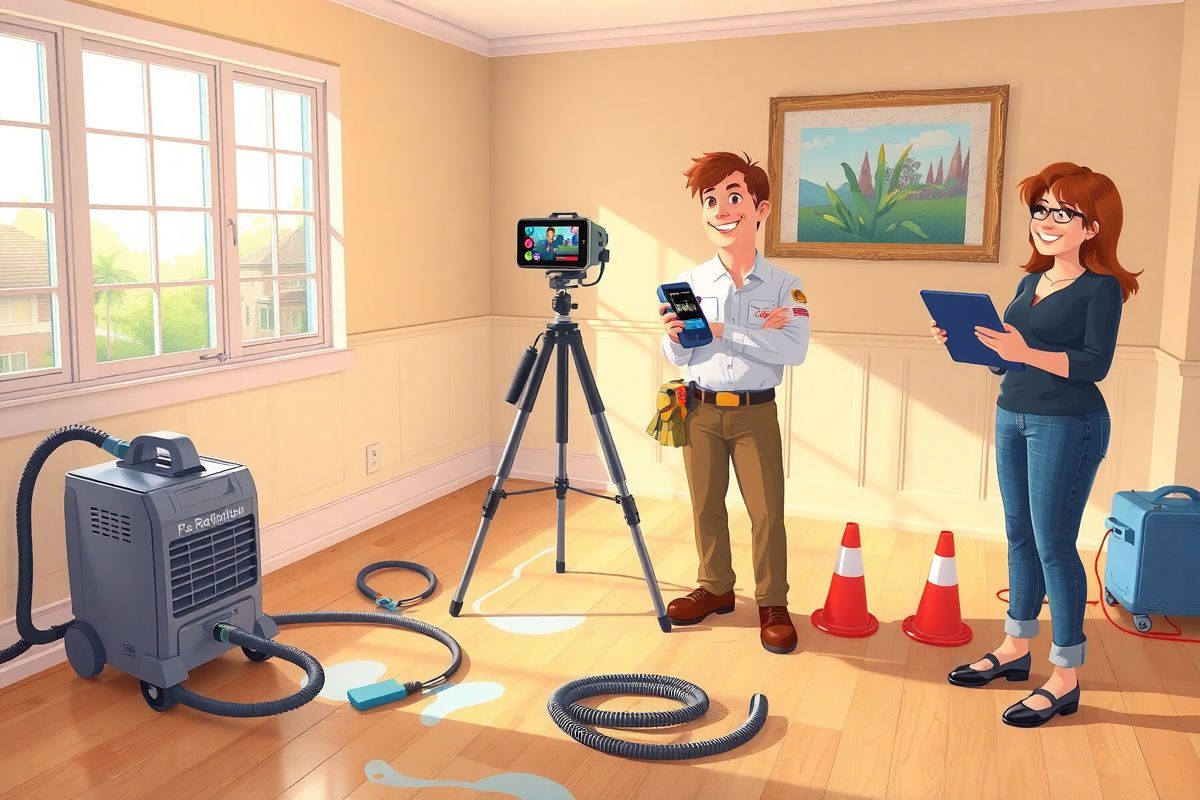
- Initial walkthroughs: technicians capture each affected space to record visible damage and moisture sources. A 360 image takes about 20 seconds per room.
- Layered documentation: teams repeat walkthroughs after demolition and after equipment placement to build a timeline. This practice reduces extra site visits.
- Remote collaboration: contractors and adjusters review the same 360 tour, therefore they align on scope and cost faster.
Examples of technology in use
- Mobile 360 cameras mounted on tripods for fast room capture. They deliver consistent height and perspective.
- Integrated LiDAR and floor plan overlays to measure room dimensions in the field.
- Cloud-hosted tours shared with adjusters, as with tools like DocuSketch.
Benefits for documentation accuracy and claims processing
- Visual proof reduces disputes because adjusters see exactly what was present at each stage.
- Faster claim resolutions result, and therefore customers regain confidence sooner.
- Estimates become verifiable, which improves estimator credibility and reputation.
How 360 imaging improves estimator reputation
Transparent, timestamped tours let estimators demonstrate their work. When professionals consistently share clear, verifiable evidence, they gain trust with homeowners and insurers. Moreover, consistent documentation supports claims in line with industry guidance, such as IICRC standards. Over time, this builds a reputation for accuracy, professionalism, and consistency.
Practical tips
- Make multiple walkthroughs standard practice. It is a simple step that protects your estimate and reputation.
Related keywords and synonyms
360 imaging, restoration documentation, walkthroughs, floor plans, LiDAR, visual proof, timeline of documentation, claims resolution, estimator credibility.
Comparing Traditional Documentation Methods versus 360 Imaging Documentation
Quick comparison to show why 360 imaging is a best practice for water damage restoration.
| Factor | Traditional documentation (photos, notes, manual measurements) | 360 imaging documentation (spherical tours, LiDAR overlays) |
|---|---|---|
| Accuracy | Limited perspective and missed angles can lead to gaps in scope. | Full-room sphere captures high, low, and in-between for comprehensive coverage. |
| Speed | Slower per room because multiple photos and notes are required. | Fast capture: about 20 seconds per room, reducing time on site. |
| Cost | Lower equipment cost but higher labor and possible repeat visits. | Higher initial equipment/software cost but lower long-term labor and fewer revisits. |
| Reliability | Depends on technician consistency and note quality; higher risk of human error. | Consistent, timestamped visual records reduce human error and boost reliability. |
| Impact on estimator reputation | Estimates can be questioned if documentation is incomplete or unclear. | Transparent visual proof supports estimates, improving credibility with homeowners and insurers. |
| Need for follow-up visits | Higher when hidden damage or missed details are discovered later. | Reduced because layered walkthroughs capture demo and equipment stages. |
| Claims resolution time | Potential delays due to limited evidence and back-and-forth. | Faster alignment with adjusters using shared tours and verifiable timelines. |
| Evidence verifiability | Single photos may be disputed or misinterpreted. | Timestamps, 360 viewpoints, and floor plan overlays create strong, verifiable evidence. |
| Mobility and workflow | Lightweight gear but manual documentation workflow. | Integrates into cloud workflows for remote review and collaboration. |
Related keywords: 360 imaging, restoration documentation, walkthroughs, LiDAR, visual proof, timeline of documentation, claims resolution, estimator credibility.
Restoration best practices: 360 imaging documentation and estimator reputation — Why estimator reputation matters
Estimator reputation is a business asset. It affects claims outcomes, homeowner confidence, and long-term referrals. When estimators document clearly, they avoid disputes. Because reputation is built on evidence and consistency, documentation matters as much as technical skill.
Real-life inspired example: the disputed multiunit loss
In a large multiunit loss, a contractor submitted an estimate with only spot photos and notes. Adjusters questioned the scope. As a result, the homeowner faced delays. The contractor lost trust and a future referral. However, when teams use 360 imaging and layered walkthroughs, they create a timestamped visual timeline. Adjusters see the demo stage and equipment placement, and therefore they align faster on scope.
How documentation quality ties to reputation
- Transparent evidence reduces arguments because photos and timestamps support the estimate.
- Consistency matters because repeated clear deliverables build professional credibility.
- Remote review saves time, and therefore clients perceive the estimator as efficient and reliable.
Best practices to protect and grow estimator reputation
- Make multiple walkthroughs standard practice: initial, post-demo, and equipment placement.
- Use timestamped 360 tours and retain them in cloud storage for claims reviews.
- Follow industry standards, such as those from the IICRC, to align methods with peers.
- Share visual tours with adjusters early to prevent scope disputes and delays.
- Keep communications professional and documented because every call and email shapes reputation.
When estimators consistently pair accurate 360 imaging with clear communication, they build trust with homeowners and insurers. As a result, they improve claim outcomes and strengthen long-term business relationships.
Restoration best practices: 360 imaging documentation and estimator reputation — Conclusion
Clear documentation and a strong estimator reputation protect homeowners and streamline recovery. When teams use 360 imaging, they create verifiable, timestamped proof of damage because the technology records full-room views quickly and consistently. As a result, adjusters resolve claims faster and homeowners receive trustworthy, efficient service.
Key takeaways
- Accuracy: 360 imaging captures high, low, and in-between views so nothing is missed.
- Transparency: Layered walkthroughs (initial, post-demo, equipment) create a chronological record that reduces disputes.
- Trust: Reliable documentation supports estimates and builds long-term estimator reputation with insurers and clients.
- Efficiency: Shared cloud tours reduce unnecessary site visits and speed claim resolutions.
For homeowners, this means clearer timelines, fewer surprises, and faster repairs. For restoration professionals, it means stronger credibility and fewer back-and-forths during claims. Therefore, adopting 360 imaging as a standard part of inspections is a practical step every mitigation team should take.
Practical next steps
- Make multiple 360 walkthroughs a standard procedure.
- Store tours with timestamps in secure cloud storage.
- Share tours early with adjusters to prevent delays and scope disputes.
Recommended Service: discover this trusted partner.
Company profile: This project provides practical and educational content on water damage mitigation and plumbing services across the United States. Our goal is to help homeowners understand the risks associated with leaks, floods, moisture, mold, and common plumbing issues. We share clear, accessible information on water cleanup, structural drying, damage inspections, mold prevention, and reliable plumbing solutions. All of our content is designed to support home safety and maintenance, backed by the availability of certified technicians in every state, ready to assist 24/7 nationwide. Nothing in our articles replaces professional evaluations, repairs, or recommendations from qualified specialists.
Online profiles: Website: https://plumbingandwatercare.blog/
Blog: https://plumbingandwatercare.blog/blog/
Frequently Asked Questions — Restoration best practices: 360 imaging documentation and estimator reputation
What is 360 imaging and how does it help during water damage restoration?
360 imaging captures a full spherical view of a room in a single sweep. It records ceiling to floor and every wall, and a single capture takes about 20 seconds per room. As a result, teams build visual, timestamped walkthroughs that reduce follow-up visits and speed claims.
Will 360 imaging compromise my privacy or show sensitive items?
No. Technicians focus on structural damage and affected areas. However, if homeowners prefer, teams can blur or exclude personal items. Most vendors use secure cloud storage and follow privacy policies to protect your data.
Does adding 360 imaging increase the cost of restoration?
Initially, it may raise equipment or software expenses. However, 360 imaging reduces labor, minimizes repeat site visits, and accelerates claim resolution. Therefore, many teams see a net savings and faster repairs for homeowners.
How does 360 imaging affect an estimator’s reputation with insurers and clients?
Transparent, timestamped tours create verifiable evidence. As a result, adjusters align on scope faster and disputes drop. Consistently sharing clear documentation builds trust and strengthens estimator credibility over time.
What should I ask a restoration company about their documentation practices?
Ask whether they perform multiple walkthroughs (initial, post-demo, equipment), if they timestamp and store tours securely, and whether they share tours with adjusters. Also ask about adherence to industry standards, because professional consistency matters.